
Gallery
Eduardo Salse
Brazil
Credits
This project explores the integration between architecture and landscape through a fluid, parametric gesture that emerges naturally from the terrain. Conceived as a museum, the building seeks to dissolve the boundary between built form and environment, allowing the structure to behave as an extension of the topography rather than an imposition upon it.
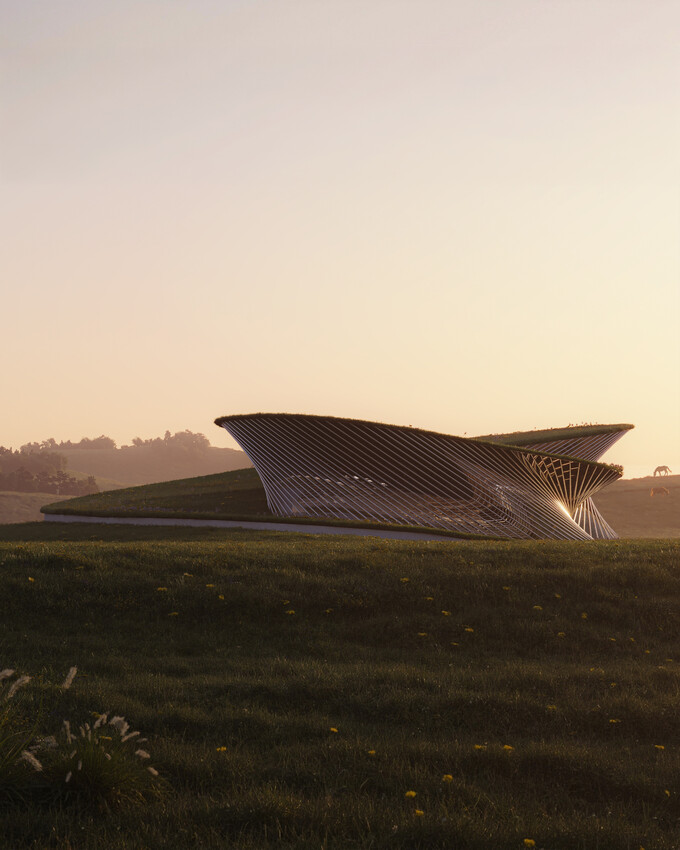
The design is driven by a system of continuous structural ribs that define both enclosure and expression, creating a dynamic interplay of light, shadow, and transparency. This porous geometry allows the surrounding landscape to visually and physically permeate the space, reinforcing a sense of openness and immersion.
The roofscape is treated as a living surface, blending vegetation with architecture to further anchor the project within its context. Visitors experience the museum not only as an interior journey but also as a walkable terrain, where circulation flows seamlessly between inside and outside.
The atmosphere of the scene emphasizes calmness and contemplation, with soft natural lighting enhancing the materiality and form. The presence of wildlife and untouched surroundings reinforces the idea of coexistence between culture and nature.
This project is a study of how parametric design can be used not only for formal expression but as a tool to create meaningful spatial relationships between architecture, landscape, and experience.
Notes
This project explores the integration between architecture and landscape through a fluid, parametric gesture that emerges naturally from the terrain. Conceived as a museum, the building seeks to dissolve the boundary between built form and environment, allowing the structure to behave as an extension of the topography rather than an imposition upon it.
The design is driven by a system of continuous structural ribs that define both enclosure and expression, creating a dynamic interplay of light, shadow, and transparency. This porous geometry allows the surrounding landscape to visually and physically permeate the space, reinforcing a sense of openness and immersion.
The roofscape is treated as a living surface, blending vegetation with architecture to further anchor the project within its context. Visitors experience the museum not only as an interior journey but also as a walkable terrain, where circulation flows seamlessly between inside and outside.
The atmosphere of the scene emphasizes calmness and contemplation, with soft natural lighting enhancing the materiality and form. The presence of wildlife and untouched surroundings reinforces the idea of coexistence between culture and nature.
This project is a study of how parametric design can be used not only for formal expression but as a tool to create meaningful spatial relationships between architecture, landscape, and experience.